Enquire Now: +91-84271-55511

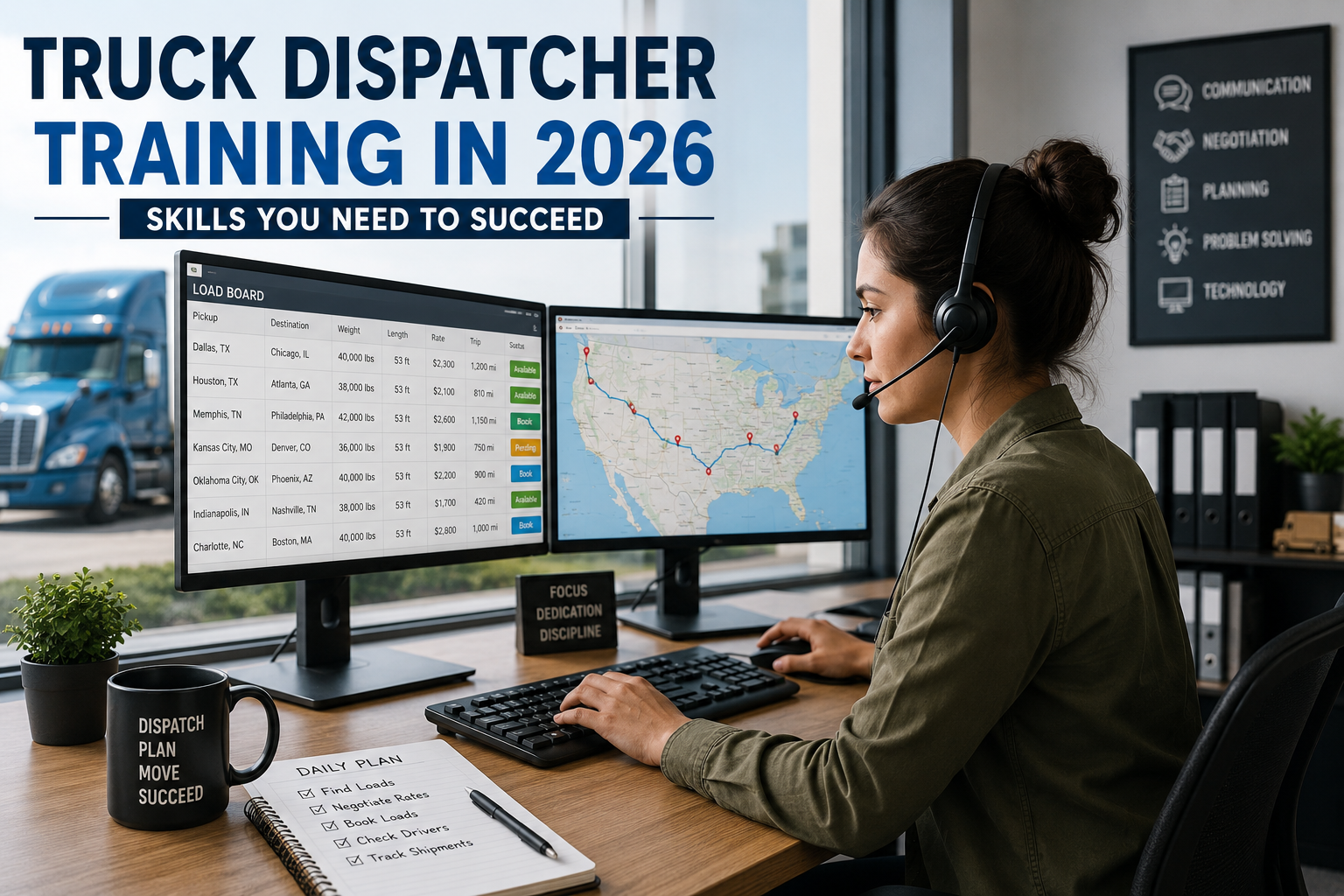
Truck Dispatcher Training in 2026: Skills You Need to Succeed
The trucking industry continues to evolve, and truck dispatching is changing with it. Technology, digital load boards, transportation management software, and AI-powered tools are becoming increasingly important in everyday freight operations.
For anyone considering a career in dispatching, this means that truck dispatcher training in 2026 is about more than simply finding loads. A successful dispatcher needs a combination of industry knowledge, communication skills, technology skills, organization, and the ability to make smart decisions under pressure.
Whether you’re completely new to trucking or looking to develop professional dispatching skills, understanding what today’s industry expects can help you prepare for a successful career.
What Does a Truck Dispatcher Do?
A truck dispatcher helps coordinate the movement of freight between carriers, drivers, brokers, and other parties involved in transportation.
Depending on the operation, a dispatcher may be responsible for:
- Finding suitable freight and available loads
- Communicating with freight brokers
- Negotiating rates and load terms
- Coordinating pickup and delivery schedules
- Planning efficient routes
- Communicating with drivers
- Tracking shipments
- Managing paperwork and load documents
- Handling delays and unexpected problems
- Monitoring a truck’s overall schedule and productivity
The role requires strong communication and organization because dispatchers often have to manage multiple loads, drivers, and conversations at the same time.
Why Truck Dispatcher Training Matters in 2026
You can find information about truck dispatching online, but professional training can help you understand how different parts of the process work together.
A structured truck dispatcher training program can introduce students to real-world concepts such as load boards, rate confirmations, broker communication, route planning, carrier operations, and dispatch software.
The goal isn’t simply to learn terminology. It is to develop the confidence to apply that knowledge when working with actual freight situations.
10 Skills Every Truck Dispatcher Should Develop in 2026
1. Load Board Skills
Load boards are an important part of modern freight dispatching. Dispatchers need to know how to search for loads, compare available options, review important load information, and identify opportunities that make sense for a carrier.
Training should provide practical experience with the process rather than only explaining what a load board is.
2. Broker Communication
Communication is at the heart of truck dispatching.
Dispatchers regularly communicate with brokers and other transportation professionals. They need to ask the right questions, confirm important details, communicate professionally, and maintain good working relationships.
Clear communication can also help prevent misunderstandings about pickup times, delivery requirements, rates, and other load details.
3. Rate Negotiation
Negotiation is another valuable dispatcher skill.
A dispatcher should understand the factors that influence a load’s value and be comfortable having professional rate conversations with brokers.
Good negotiation isn’t simply about asking for the highest possible rate. It involves understanding the overall trip, mileage, operating costs, timing, market conditions, and the carrier’s requirements.
4. Understanding RPM and Trip Profitability
Knowing the rate of a load is not enough.
Dispatchers should understand concepts such as:
RPM (Rate Per Mile)
RPM helps dispatchers evaluate a load in relation to its mileage.
For example, two loads may offer different total rates, but the load with the higher total payment isn’t necessarily the better option. Mileage, deadhead, route, timing, and other factors need to be considered.
This is why basic calculations and profitability analysis are important parts of truck dispatcher training.
5. Route Planning
A dispatcher needs to think beyond the pickup and delivery addresses.
Good route planning considers:
- Total mileage
- Deadhead miles
- Pickup and delivery schedules
- Driver availability
- Traffic and road conditions
- Equipment requirements
- Potential delays
- Opportunities for the next load
Efficient planning can help reduce unnecessary miles and keep a truck moving productively.
6. Technology and TMS Software
Technology has become a major part of transportation operations.
Modern dispatchers may work with load boards, transportation management systems (TMS), tracking platforms, communication tools, spreadsheets, and other digital systems.
A dispatcher doesn’t need to be a software developer, but they should be comfortable learning new tools and using technology efficiently.
7. Documentation and Attention to Detail
A small mistake in transportation can create unnecessary problems.
Dispatchers should develop strong attention to detail when reviewing:
- Rate confirmations
- Pickup and delivery information
- Broker details
- Carrier information
- Appointment times
- Load requirements
- Proof-of-delivery documents
- Other transportation paperwork
Developing good documentation habits is an important part of becoming a reliable dispatcher.
8. Problem-Solving
Things don’t always go according to plan in trucking.
A driver may experience a delay. A facility may change an appointment. Traffic can affect arrival times. A load may have unexpected requirements.
A dispatcher needs to remain calm, gather the relevant information, communicate with the appropriate people, and work toward a practical solution.
Problem-solving is one of those skills that becomes stronger through practice and real-world scenarios.
9. Professional Communication
Truck dispatchers communicate with different people throughout the day.
That means being able to:
- Speak professionally
- Write clear messages and emails
- Ask effective questions
- Listen carefully
- Communicate accurate information
- Stay professional during difficult conversations
Strong communication can make a significant difference when building relationships with drivers, brokers, carriers, and customers.
10. Time Management and Multitasking
A dispatcher may have several active loads and conversations at the same time.
They need to prioritize tasks and keep track of important deadlines without losing important details.
Good time management can help dispatchers stay organized when handling multiple trucks and changing schedules.
Will AI Replace Truck Dispatchers?
AI and automation are becoming increasingly relevant in transportation, and dispatching is no exception.
AI-powered systems can assist with tasks such as information processing, load matching, communication, and other repetitive activities.
However, technology does not eliminate the need for human judgment.
A dispatcher still needs to understand the carrier’s needs, evaluate different options, communicate with people, handle unexpected situations, and make decisions when circumstances change.
For new dispatchers, the better approach is to learn how to work with technology rather than ignore it.
What Should You Look for in Truck Dispatcher Training?
Not every course provides the same type of learning experience.
Before choosing a truck dispatcher course, look for training that covers practical industry skills such as:
- Load board operations
- Freight and carrier terminology
- Broker communication
- Rate negotiation
- RPM calculations
- Route planning
- Dispatch software
- Documentation
- Real-world dispatch scenarios
- Interview and career preparation
Practical exercises can be especially valuable because they allow students to understand how different skills are used together.
Can Beginners Become Truck Dispatchers?
Yes. Truck dispatching can be learned by people who are new to the transportation industry.
The important thing is to build a strong foundation instead of trying to learn everything at once.
A beginner can start by learning trucking terminology, understanding how freight moves, becoming familiar with load boards, practicing broker communication, and developing basic calculations and documentation skills.
With structured training and consistent practice, these skills can become much easier to apply.
Truck dispatching in 2026 requires a combination of industry knowledge, technology skills, communication, organization, negotiation, and problem-solving.
The role continues to evolve as transportation companies adopt new digital tools and automation. For aspiring dispatchers, this makes practical and up-to-date truck dispatcher training more valuable than ever.
If you’re considering a career in truck dispatching, focus on developing skills that you can actually apply in day-to-day freight operations. The stronger your foundation, the more confidently you can communicate with brokers, support drivers, evaluate loads, and manage the challenges that come with the job.
Ready to start learning truck dispatching?
Explore our truck dispatcher training program to learn the practical skills needed to build your knowledge and prepare for opportunities in the transportation industry.